
Welcome to Guan Academy
Guan Academy of Chinese Medicine was founded in 2025 by Peter Firebrace and Kathaline Lauge Firebrace. We have both taught for many years and have decades of clinical practice, so giving us a wealth of experience and knowledge to share. We both have a vision with this platform to share and give out all that was given to us for the last forty years and to explore further and dig deeper. (more…)

NEW COURSE 2026
*
NEW COURSE 2026 *
TIME, TIMING AND THE TIMELESS
FOLLOWING THE CHINESE CALENDAR’S CALL
PETER FIREBRACE
A Guan Academy course in partnership with Net of Knowledge
Time is a continuum. Now is always with us. But around us there is always change. Sun up sun down, new moon full moon, spring summer autumn winter. Each day is always different. Time gives particular qualities of qi, definite, quantifiable, with different effects. Nature is governed by time. Plants and animals, we are all programmed by time. Light dark light dark, that constant day night rhythm. Awake, asleep, awake asleep, our faithful response.
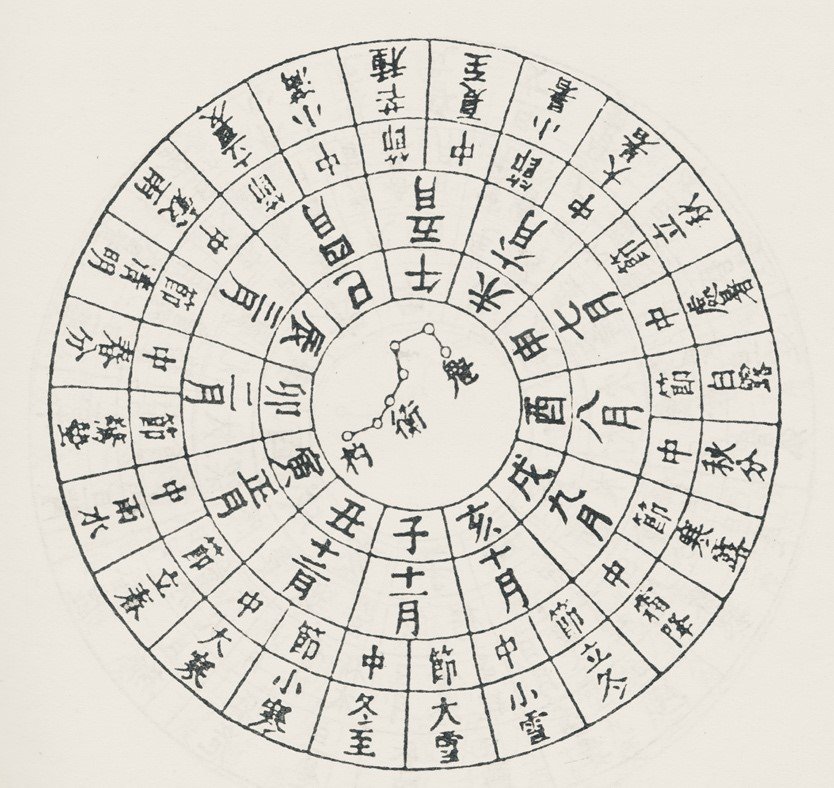
In this course we will follow the keen observational skills of the traditional Chinese sol-lunar calendar. From the solar calendar we will make a detailed study of the 4 seasons, 6 climates, 24 solar fortnights jie qi 節 氣, 72 x 5 day periods hou 候 and associated 64 hexagrams. We will also practise the 24 seated qi gong exercises that are associated with the 24 solar fortnights, each one focussing on one of the 24 vertebrae in turn.
From the lunar calendar we will observe the 12 lunar months, the first beginning at Chinese new year, the second new moon after the winter solstice on February 17th. Successive new and full moons through the year give important festivals with traditional practices.
We will also study the sexagenary cycle of the 10 heavenly stems and 12 earthly branches, an ancient counting system used simultaneously for the years, months, days and hours, which links to the elements, seasons, organs and meridians. 2026 is a fire horse year, being 丙 午 bing wu, stem 3 fire branch 6 fire.
With each of the 12 sessions we will study the various seasonal aspects for the coming month and how they affect our organs, meridians and health. We will certainly become more in tune with the time ourselves and will learn how to use time and timing to help our patients.
Once you have registered for the event, you will receive access to the live program on Net of Knowledge 10 days before it begins. To attend the event, you will need to log in to your Net of Knowledge account and attend in full to be able to access your certificate. For any questions related to your account or during the event, please reach out to support@netofknowledge.com.
DATES AND TIMES
12 monthly 3 hour online classes
SPRING Sunday 1 February, 1 March, 29 March
SUMMER Sunday 26 April, 31 May, 5 July
AUTUMN Sunday 2 August, 6 September, 4 October
WINTER Sunday 1 November, 6 December, 3 January
12 Sunday classes of 3 hours each:
London: 5:00 to 8:00 pm – Central European Time: 18:00 to 21:00
Pacific Time: 09:00 to 12:00 am – Eastern Time: 12:00 to 3:00 pm
COST
$890 US
or 2 payments of $485 US
or 4 seasonal payments of $260 US
Payment for one season only: $290 US
CERTIFICATE
Certificate given on completion of complete course
3 hour CEUs given after each class
Click the button for more information and to apply for a course.
FURTHER DETAILS ON THE COURSE
TIME, TIMING AND THE TIMELESS
FOLLOWING THE CHINESE CALENDAR’S CALL
A detailed understanding of time has been important since the earliest times in China and, apart from the benefits to agriculture, there are also major implications for improving the results of treatment. This course will present all the fundamental aspects of the circle of time and how to make best use of them as the year unfolds.
We will use China’s ancient Xia Calendar, also known as the Farmer’s Calendar or 10,000 Year Calendar. This is a combined solar and lunar calendar, that also includes the sexagenary cycle of the 10 heavenly stems and 12 earthly branches.
A course description follows.
THE SOLAR CALENDAR
The solar calendar gives the 4 seasons si shi 四 時, the 24 x 15 day solar periods jie qi 節 氣 and 72 x 5 day periods hou 候.
THE 4 SEASONS are presented as models for us to follow in our behaviour, giving appropriate advice to nourish and strengthen the associated organ and guard against disease eg in Suwen 2 Attune the Spirits to the Qi of the Four Seasons.
Other texts offer various methods of choosing seasonal points.
Associated hand or foot meridians are matched to the three months of each season eg for winter the first month is foot jue yin liver, the second month is foot shao yin kidneys, the third month is foot tai yin spleen. This is a different matching than the meridian cycle and is used in the 5 Movements 6 Qi system in the Suwen.
THE 24 X 15 DAY SOLAR PERIODS have been an intrinsic part of Chinese culture for thousands of years, used as guides for the planting, growing and harvesting of crops, foods and herbs and giving rise to festivals with particular customs and beneficial foods. Importantly they give the start and midpoint of each of the seasons and indicate expected weather conditions. They start with Beginning of Spring li chun 立 春, February 4th in 2026, where treatment shifts from the kidneys in winter to the liver in spring. Many other systems of calculating time relate to the 24 solar periods eg they give the start and midpoints of the astrological signs such as Rain Water 18th February is 0º Pisces. Other calendars can be directly related eg the Celtic calendar also contains the Spring and Autumn Equinox, the Winter and Summer Solstice and the cross-quarter days of Imbolc, Beltane, Lughnasadh and Samhain are listed by the solar periods as the start of each of the four seasons of spring, summer, autumn and winter respectively. Comparison with other cultures will be made when appropriate. Two solar periods will be covered each session.
Seated qi gong exercise. The nei dan 內 丹 internal alchemy tradition have long made correlations between the 24 solar terms and the 24 vertebrae on the spine. For example the 5th lumbar vertebra relates to the Winter Solstice, 21st December in 2026, and this fortnightly period is the time to focus on this vertebra with a particular seated qi gong exercise and meditation. Through the year we will practise focussing on each vertebra in turn with the appropriate exercise.
The seasonal climates or host energies are the normal expected climates of the year, 6 x 60 day periods related to the 6 divisions eg Jue Yin Wind starts from Great Cold 20th January 2026 for 4 solar terms. Knowing these we can guard against the negative aspects and take advantage of the positive aspects in our treatments. These are also used in the 5 Movements 6 Qi system at the end of the Suwen.
THE 72 X 5 DAY PERIODS give particular images of nature in their time such as hibernating insects awakening, ice thawing or stags losing their antlers, often key changes in flora and fauna.
Each is also linked to a hexagram from the Yi jing Book of Changes, illustrating the nature of the changes that take place as the year turns eg Hexagram 24 fu 復 Return at the Winter Solstice, when the yang returns.
THE LUNAR CALENDAR
The lunar calendar gives 12 lunar months in the year, starting at the second new moon after the Winter Solstice, February 17th in 2026. This is called Spring Festival chun jie 春 節 in China, widely known as Chinese New Year, the largest and longest annual festival, an important time of family reunion. The lunar months are linked to the 12 branches, the first lunar month being branch 3 yin 寅.
New and full moons, the 1st and 15th days of each lunar month are always important eg Mid Autumn Festival zhong qiu jie 中 秋 節, celebrated with moon cakes at the full moon of the 8th lunar month in autumn. Traditionally this was a ceremony led by women, showing respect to the yin. In 2026 it is on September 25th.
Same number day and month give important festivals such as 9th day of 9th lunar month zhong yang jie 重 陽 節 festival, also known as Double Nine Festival when the ancestors are remembered. It is October 18th in 2026.
HEAVENLY STEMS AND EARTHLY BRANCHES
10 Heavenly Stems and 12 Earthly Branches, the Sexagenary Cycle
Intimately related to yin yang, 4 seasons and 5 elements, the 10 heavenly stems and 12 earthly branches are an ancient counting system for the years, months, days and double hours. Yin joining yin and yang joining yang, they form a sexagenary cycle of 60 pairs. A complete cycle for the years takes 60 years, for the months takes 60 months or 5 years, for the days takes 60 days or 2 months and for the double hours takes 60 double hours or 5 days.
For the 10 heavenly stems, stems 1 and 2 jia yi 甲 乙 are related to wood and spring, stems 3 and 4 bing ding 丙 丁 to fire and summer, stems 7 and 8 geng xin 庚 辛 to metal and autumn, stems 9 and 10 ren gui 壬 癸 to water and winter, stems 5 and 6 wu ji 戊 己 to the centre, earth.
For the 12 earthly branches, branches 12 and 1 hai zi 亥 子 are related to water and winter, branch 2 chou 丑 to earth and winter; branches 3 and 4 yin mao 寅 卯 are related to wood and spring, branch 5 chen 辰 to earth and spring; branches 6 and 7 si wu 巳 午 are related to fire and summer, branch 8 wei 未 to earth and summer; branches 9 and 10 shen you 申 酉 are related to metal and autumn, branch 11 xu 戌 to earth and autumn.
The stem gives the element, the branch one of the animals. So for example 2026 is the year of stem 3 bing 丙 and branch 7 wu 午. Stem 3 bing 丙 is fire and branch 7 wu 午 is also fire and as an animal is the horse, so bing wu 丙 午 is then a Fire Horse year and we expect an excess of fire. Following the same process with the stem and branch of the month, day and double hour gives the 8 characters ba zi 八 字, the basic horoscope for fortune-telling. This is a detailed system using the stems and branches, but too large to cover on this course. The material we do cover will however be an excellent introduction to further studies.
5 Movements 6 Qi system wu yun liu qi 五 運 六 氣
Stems, branches, elements, solar terms, climates and 6 divisions are all part of the wu yun liu qi 5 Movements, 6 Qi system, which is described in great detail in chapters 66 to 71 and chapter 74 of the Huangdi Neijing Suwen. This course will then give much of the background that will be useful to study further. The 5 Movements 6 Qi system is too big a subject to be covered in detail on the course, but a summary will be given of the expected imbalances in 2026.
Traditional pictures and images will be shared and my own photos of nature will be shown each session to illustrate the changes in the year at different times. As we can see, this is a wide-ranging course that will cover multiple fields. The aim is to produce a dynamic, informative and enjoyable course that will allow us all to be more in tune with the times as they appear throughout the year and use that understanding to improve our treatments.